I
had the privilege of joining President Barack Obama and a small cadre
of Black journalists aboard Air Force One on a trip to Selma on the 50th
anniversary of Bloody Sunday.
Sitting under the Seal of Air Force
One yesterday, the President talked about the symbolism of that moment.
It wasn't lost on anyone on board, with special souvenirs and M&M
candies affixed with the president's signature, that none of us would be
there without the blood spilled by those brave men and women half a
decade earlier.
The president seemed hyper-aware of his position
as a manifestation of progress. While some cynics may declare that
"nothing has changed,” that sentiment doesn't seem to be consistent with
reality as we flew to what used to be the heart of American racial
terror.
While President Obama's election isn't the catalyst of a
post-racial America fiction, that doesn't mean it was not
transformational for the next generation. "I think that there’s no doubt
that my election was a significant moment in the country’s racial
history. I say that with all humility. If it hadn’t been me, it would
have been somebody else. But a barrier was broken," the president said.
"I think that legacy will continue in the minds of children who are
growing up never having known to this point a President who wasn’t
black. And I think that shapes attitudes among young African American
children, but also among all children. And I’d like to think that that
will have a useful, lasting effect in terms of people’s attitudes about
who can do what, and changes people’s images of what’s possible for any
child in America."
The president's children, Sasha and Malia, were
there to bear witness and honor those who made our self-determination,
through the vehicle of voting, possible. "[T]he thing that makes it most
important for me is not what I have to say, but rather giving Malia and
Sasha a chance to soak in some of the history that has given them
opportunities that 50 years ago never could have been imagined, and that
like all young people they may tend to sometimes take for granted."
Selma was a moment in which the world saw the ugly underbelly of white supremacy streaming live on national television.
Things
have changed since 1965 even though with every tragic racial incident –
from the L.A. Riots to Ferguson – American racial progress seems
especially tenuous. Fifty years ago racist Jim Crow laws codified
discrimination against Black people and denied their civil rights and
basic human dignity. While the mechanics have changed, much of this bias
has been embedded in our institutions, and at times it seems that while
everything about race relations has changed, much remains the same.
President
Obama noted this interesting timing; just days before his trip to
Selma, the Department Of Justice confirmed, in a comprehensive report on
the Ferguson police department, what the #BlackLivesMatter movement has
been protesting around the nation since last summer. The 100 page
report documents, in detail, the problem, and outlines a path forward in
Ferguson and beyond.
"In some ways, the timing is good – the
week that the report on Ferguson came out [is] around the same time that
the task force that I put together in the aftermath of Ferguson [is]
presenting its findings and recommendations too," President Obama said.
Speaking
about how "Selma is now," the president said, "I think we have a great
opportunity to not duplicate the spirit of 50 years ago, but at least
draw inspiration from it and try to apply it in concrete ways that can
restore trust between community and law enforcement around the country;
that can refocus our efforts around criminal justice reform; that can
spark a conversation around the continuing legacies in Jim Crow that led
to impoverished and isolated communities; and that can provide some
impetus for reauthorization of the Voting Rights Act," President Obama
said.
Too often, Americans decry the slow pace of change. Yet one
could not question that a seismic racial transformation happened in the
last 50 years as we watched the nation's first Black president's
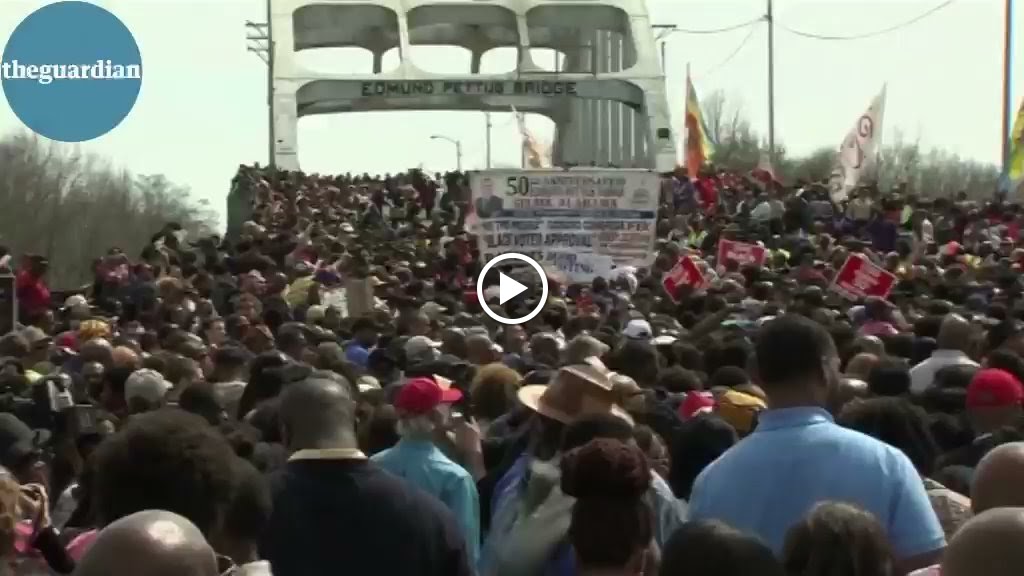
motorcade ride through Selma. Residents lined the suburban streets for
just a brief glimpse of President Obama as the First Family made their
way to a crowd of 40,000 people ready for a celebration.
“[T]here
are places and moments in America where this nation’s destiny has been
decided. Many are sites of war – Concord and Lexington, Appomattox,
Gettysburg. Others are the sites that symbolize the daring of America’s
character – Independence Hall, Seneca Falls, Kitty Hawk and Cape
Canaveral. Selma is such a place, the president said opening his rousing
speech at the foot of the famous bridge.
Fifty years ago my late
grandfather Reverend Elmer Williams marched across the Edmund Pettus
Bridge and this weekend I went to Selma with America's President. Both
of us are Black. Both of us would've been targets of violence in the
Selma of yesteryear but, today, the President drove to and marched over
this bridge, the staging for brutal confrontations, as the leader of the
free world.
Zerlina Maxwell,
J.D., is a political analyst and ESSENCE contributor. She writes about
national politics, candidates, and specific policy and culture issues
including domestic violence, sexual assault, victim blaming and gender
inequality.
Michael W. WatersBecome a fanAward-Winning
Author of Freestyle: Reflections on Faith, Family, Justice, and Pop
Culture; Founding Pastor of Joy Tabernacle A.M.E. Church in Dallas,
Texas
The animus for Time Magazine's "song of the 20th century" was
a photograph of a Southern lynching. A Southern lynching would often
draw an entire region of spectators together for a day of socializing.
Small children were even present in the crowd, lifted high upon shoulder
for an uninterrupted view of the day's fatal proceedings. It was a
strange, albeit frequent Southern spectacle, one that claimed many Black
lives.
Given the frequency of this horrid practice, and the
abundance of lynching photographs in circulation, many that doubled as
postcards, it is unclear why one particular photograph troubled, then
inspired Abel Meeropol, a New York English teacher and poet. Yet, it
did. Unable to free his mind of this troubling image over several days,
Meeropol sought consolation through his pen. As ink dried upon its
canvas, its residuum formed words that have haunted generations, words
etched into our collective memory as lyric by the incomparable Billie
Holiday: "Southern trees bear a strange fruit,
Blood on the leaves and blood at the root,
Black body swinging in the Southern breeze,
Strange fruit hanging from the poplar trees."
Now seventy-six years removed its initial recording, there is still cause to sing this sorrowful song.
On
August 29, 2014, another Black body was added to the crowded annals of
those swung by Southern breeze. In a cruel twist of irony, the body of
seventeen year-old Lennon Lacy was not found swinging upon a Southern
tree, but upon a Southern swing set - a fact only beginning the
strangeness surrounding his death. Authorities in Bladenboro, North
Carolina, abruptly ruled Lennon's death a suicide, declaring that he was
depressed, and closed the case in five days.
Still, many questions remain.
Why did authorities fail to place bags over Lennon's hands to prevent contamination and preserve DNA from a possible struggle?
Why didn't authorities take any pictures at the scene of Lennon's death?
Why were the shoes found on Lennon's feet not the same shoes that he departed from home wearing?
Why were the shoes found on Lennon's feet a size and a half smaller than his foot size?
Why
were those same shoes removed from the body bag between the time his
corpse was placed in the body bag and the time the body arrived at the
medical examiner's office?
Strange.
Very strange.
Strange,
still, is an independent examiner's conclusion that declaring Lennon's
death a suicide is virtually impossible given Lennon's height, weight,
and the items found at the scene.
The circumstances surrounding
Lennon's death, however, begin to lose some of its strangeness when the
fact that he was in an interracial relationship with a white woman in an
area still ripe with racial tension, and where the Ku Klux Klan has an
active presence, is brought to the fore. History has taught us time and
time again that when authorities move too quickly to close a case, a
cover-up is afoot. With so many questions surrounding Lennon's death,
the move to close his case remains startlingly strange, and it is cause
for great concern. Thankfully, the FBI is now investigating the case.
Strange, still, is how justice for so many Black lives remains so fleeting.
Strange, still, is how swiftly certain tragedies that befall Black lives are swept under the rug.
Strange,
still, is the spectacle of a Southern lynching upon a swing set, a
symbol of youthful euphoria now rendered the site of a Black youth's
strangulation. Of Meeropol and Holiday's "Strange Fruit," the late jazz
writer Leonard Feather penned that it was "the first significant protest
in words and music, the first unmuted cry against racism." The very
nature of a lynching is to render the victim forever mute --
asphyxiating in suspended space -- the violent snapping of the neck.
While Lennon Lacy is forever muted, we who love justice must become for
him as Meeropol and Holiday: an unmuted cry.
We must continue to pen Lennon's story.
We must continue to sing Lennon's song.
We must continue to seek answers to strange circumstances.
We must continue to seek justice for another Black life, a life, strangely, still, gone too soon. This
post is part of the "28 Black Lives That Matter" series produced by The
Huffington Post for Black History Month. Each day in February, this
series will shine a spotlight on one African-American individual who
made headlines in 2014 -- mostly in circumstances we all wished had not
taken place. This series will pay tribute to these individuals and
address the underlying circumstances that led to their unfortunate
outcomes. To follow the conversation on Twitter, view #28BlackLives --
and to see all the posts as part of our Black History Month coverage,
read here.
By Lamont Lilly
November 4, 2014 “The nineteenth century lynch mob cuts off ears, toes and fingers,
strips off flesh and distributes portions of the body as souvenirs among
the crowd.” —Ida B. Wells,“Lynch Law in America.” Jan. 1900, pp. 15-24
Lennon Lacy
Lennon Lacy did not hang himself; he was lynched! He did not commit
suicide; he was murdered! Capturing the correct language is so critical
in this case, which is probably why mainstream media have refused to
cover it. The correct language reflects a history the U.S. would rather
not share, while “lynching” is a word most Black folk would rather
forget. The harsh reality is that Lennon Lacy, a 17-year-old Black kid
from North Carolina was lynched just two months ago. What happened?
It was on Friday, Aug. 29, that 17-year-old high school student
Lennon Lee Lacy was found hanging from a wooden swing set in Bladenboro,
N.C. His lifeless body was left dangling in thin air on a makeshift
rope. His neck was visibly marked with dark abrasions from
asphyxiation. A belt buckle imprint was found just below his right ear.
There were lacerations on his face, arms and chest; bruises on his
chin, cheeks and nose; a series of unexplained scratches on his scrotum;
and an enlarged knot on the right side of his forehead.
The black Air Jordan sneakers Lacy was originally wearing were
removed and replaced with a pair of sneakers no member of his family was
able to recognize. Though Lennon’s feet were a size 12, the white
sneakers placed on his feet at his time of death were a size
ten-and-a-half. Lennon’s mortician, F.W. Newton, described the body as
if he “had been killed in a barroom fight.” (theguardian.com, Oct. 9)
As if Lacy’s lynching was not enough, just a few days after he was
laid to rest, someone (or some group) dug a small hole on top of his
grave. They also destroyed the floral arrangement that friends and
family had placed at his burial marker, tossing the arrangement
alongside the road 40 feet away. While local authorities are suggesting
suicide, the Black community is calling the Lacy case for what it is: a
2014 lynching. Every reason to live
On the evening of Lennon Lacy’s disappearance, his father, Larry
Walton, was the last family member to see him alive. According to
Walton, his son Lennon had every reason to live. His high school
football team was scheduled to play their first game of the season later
that evening. Lennon’s dream was to play in the National Football
League. He was a linebacker whose size, skill and work ethic basically
guaranteed a scholarship to college. His performance in the classroom
was equally stellar.
Local residents have spoken highly of Lennon’s character, manners and
overall demeanor. Lennon was also active in his church youth group,
had no criminal record and no history of mental illness. His only “harm
to society” was dating a white woman who lived nearby. Local residents
were well aware of Lacy and 31-year-old Michelle Brimhall’s “intimate
interactions,” which garnered a heaping of local gossip and disdain.
Some things have not changed down South: the general attitude toward
Black men dating white women just happens to be one of them. Jim Crow and the Southern Confederacy
Bladenboro, N.C., is a small town of 1,746 residents located just
outside of Wilmington, N.C. Nicknamed “Crackertown” by local Black
residents, Bladenboro is 80 percent white and well known for its
ingrained racism within the social order.
For those unfamiliar, Wilmington is the home of the 1898 Race
Massacre, a two-day armed attack on Wilmington’s Black middle class by
white terror mobs. What that moment literally created was Jim Crow
segregation — an oppressive and bloody end to Reconstruction and
post-slavery progress.
Wilmington was also the site of the 1971 frame-up of The Wilmington
10 (who were finally pardoned by N.C. Gov. Beverly Perdue in 2013).
Such history and close proximity means everything.
This history contributes to the political and social climate of the
community. White supremacy was, at one time, the law in North Carolina.
Many would argue it still is. Keep in mind that between 1882 and 1968
there were 86 Black folks lynched in this state — and those are just
the lynchings we know of. Ironically, neighbors of the Lacy family had
just recently been made to remove a sign in their front yard that read
“N——-s Keep Out.” Police botch investigation
Stating that local authorities have failed to conduct a thorough
investigation in this case is an understatement. It has been reported
that Lacy’s fingernails were not properly swabbed for DNA testing. His
hands, body hair and mouth were not examined either. Due to the
presumption of suicide, Lennon’s neighbors, friends and Michelle
Brimhall, have not been questioned.
It is obvious the Bladenboro Police Department has not taken this
matter serious. A 200 pound teenager was found hanging from a swing set
in the middle of a trailer park, and no one knows anything? No one
should be surprised if the local police department was partly involved.
It was not long ago that police officers, sheriff departments and the
Ku Klux Klan worked hand-in-hand to enforce white supremacy,
particularly throughout the South.
Those learning of this case for the first time: tweet, Instagram and
Facebook it. Dig deep and research the history. Tell your friends
around the world how a 17-year-old Black boy was lynched in North
Carolina on Aug. 29, 2014. Tell the world how the U.S. is still racist
and lackadaisical in the pursuit of justice for all. Tell the world how
democracy does not really exist here. In the case of Lennon Lacy, tell
the truth. Lennon Lee Lacy did not hang himself; he was lynched. He
did not commit suicide; he was murdered. “Our country’s national crime is lynching. It represents the
cool, calculating deliberation of intelligent people who openly avow
that there is an “unwritten law” that justifies them in putting human
beings to death without complaint under oath, without trial by jury,
without opportunity to make defense, and without right of appeal.” — Ida B. Wells Lamont Lilly is a contributing editor
with the Triangle Free Press and organizer with Workers World Party in
Durham, N.C. Follow him on Twitter @LamontLilly.
International Action Center • Solidarity Center • 147 W. 24th St., FL 2 • New York, NY 10011 Phone 212.633.6646 • E-mail: iacenter@iacenter.org • En Español: iac-cai@iacenter.org


 I
had the privilege of joining President Barack Obama and a small cadre
of Black journalists aboard Air Force One on a trip to Selma on the 50th
anniversary of Bloody Sunday.
I
had the privilege of joining President Barack Obama and a small cadre
of Black journalists aboard Air Force One on a trip to Selma on the 50th
anniversary of Bloody Sunday.


 Previous Article