from vice.com
WE MUST HAVE A BLACK STANDARD OF BEAUTY BASED ON THE BLACK SKINNED BLACKEST WOMAN

WE MUST HAVE A BLACK STANDARD OF BEAUTY BASED ON THE BLACK SKINNED BLACKEST WOMAN

Sunday, August 02, 2015
OYOTUNJI 000000!--A YORUBA VILLAGE IN SOUTH CAROLINA!-FROM VICE.COM
from vice.com

More than four decades later, Oyotunji persists, providing a pleasant setting for converts to the Yoruba religion to live out their spiritual lives. According to a 1995 Essence article, the village had about 120 inhabitants during its mid-70s peak. Today there are around 25, and leadership has passed on to one of its founder's 22 children, Oba Adejuyigbe Adefunmi II.
Tourists are welcome to stop by the village, which sits about 50 miles outside of Charleston, near Sheldon, South Carolina. Its atmosphere of inclusiveness and cultural education stands in stark contrast to the recent church shooting and the intense fallout that resulted nearby. By all accounts, Oyotunji is not just a place to live, but a way of life: Its inhabitants construct temples to the pantheon of spirits called Orishas and pray to them every day. Curious about the life and perspectives of these traditionalist back-to-the-landers, I traveled to Sheldon, South Carolina, to learn a bit about Yoruba culture and gain some insight into Southern life in 2015. This is what they said:


Olayatan: Technology came in. We got electricity. We got running water. But somewhere between Nixon and Reagan, somewhere in there was a kind of turnaround. The economy started getting tougher. Folks were struggling for money. Then the oracle says, OK, things are going to get really tough. And we didn't know what it meant at that time, but [he was predicting] the onslaught of drugs and crime in the city.


Topics: Oyotunji, South Carolina, Yoruba, Oba Oseijem
An Oral History of the West African Village That Has Been in South Carolina for Four Decades
By Christopher Kilbourn
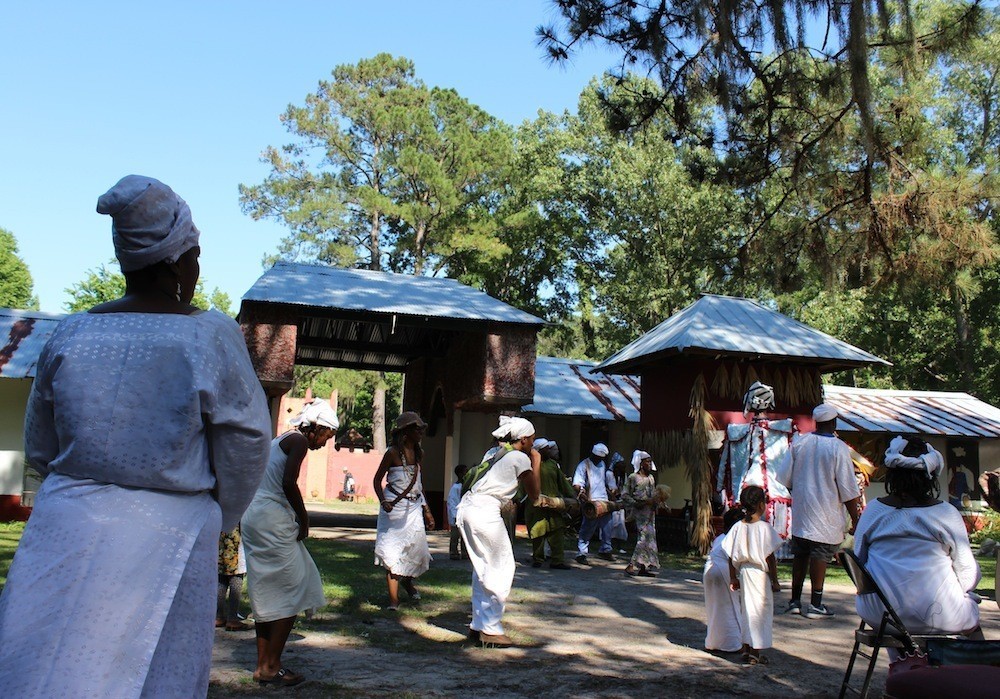
The king on his throne. All photos of an ancestor worship ceremony at Oyotunji by the author
At the tail end of the 1960s, elements within the Civil Rights Movement were having a debate about how the African-American community
at large should confront the hostile and ignorant society in which it resided. Some
advocated peaceful assimilation; others raised the idea of a violent,
apocalyptic insurrection. And a few suggested moving to rural South Carolina, establishing
a polygamous religious commune, and creating an outpost of West African culture
through regular acts of ancestor worship, animal sacrifice, and other rituals.
On VICE News: Road-Tripping to South Carolina With the 'New' KKKThis outpost is the Oyotunji African Village, founded by a man known as His Royal Highness Oba Oseijeman Adefunmi I, who in the late 60s was inspired to leave New York, purchase land in the Deep South, and establish a community born from the idea that black empowerment needed to focus on culture, not just economic independence.
More than four decades later, Oyotunji persists, providing a pleasant setting for converts to the Yoruba religion to live out their spiritual lives. According to a 1995 Essence article, the village had about 120 inhabitants during its mid-70s peak. Today there are around 25, and leadership has passed on to one of its founder's 22 children, Oba Adejuyigbe Adefunmi II.
Tourists are welcome to stop by the village, which sits about 50 miles outside of Charleston, near Sheldon, South Carolina. Its atmosphere of inclusiveness and cultural education stands in stark contrast to the recent church shooting and the intense fallout that resulted nearby. By all accounts, Oyotunji is not just a place to live, but a way of life: Its inhabitants construct temples to the pantheon of spirits called Orishas and pray to them every day. Curious about the life and perspectives of these traditionalist back-to-the-landers, I traveled to Sheldon, South Carolina, to learn a bit about Yoruba culture and gain some insight into Southern life in 2015. This is what they said:
COMING TO OYOTUNJI
Olayatan: I came for a two-week visit on
August 6, 1978. So I guess that's coming up on 37 years.
Olapeju, wife of the king: It's been about a year [since I
moved here]. My aunt was married to the first
kabiyesi ("king"—literally, "the one who no one opposes"), so my
family's been familiar with the culture for a while. I started coming down with
her a couple years back, and I fell in love with the culture, my daughter fell
in love with the culture. So we decided last year to go ahead and make the
plunge. I don't know if I'll be here forever, but I definitely am enjoying the
time that I'm here right now.
Akintobe: I heard about it in Germany. I saw
a little article in the military newspaper about a voodoo village in Beaufort [County],
South Carolina, and it showed the king sitting on a throne that perhaps he made
himself. I cut that picture out and placed it above my bed, and that's where it
stayed until I left, 30 months later. I don't know why I did it. I was
compelled by a spiritual force that I couldn't resist. And I came here in
December of '74.
Ofalaya: I met the Oba in 2003 in Key West,
Florida, when he was a prince. He came to Key West to declare one of the
beaches there an African burial ground. And I met him there. And I did some
volunteering at the African museum in Key West that he helped start. My sister's
a
Shango priest, so I wasn't
unfamiliar with the culture.
Oba Adejuyigbe
Adefunmi II
: I was born in Oyotunji in 1976, right here on the
property during a storm. And the house blew over. I remember my dad telling me
the story. And he came over there to rush and see if my mother was OK, and he
said she came crawling out holding me from under some boards.
Olpeju
Olapeju: It's
not so much a religion as it is a culture or a lifestyle. We're here to honor
our ancestors. That means I honor yours. That means you honor mine. It's a
different dynamic than just going to church on Sunday and praying.
Akintobe: This
is not part-time. Full-time. Twenty-five hours, daily. Sleeping, wake up, it's
part of you. Go to bed saying certain things, wake up saying certain things. God,
God. To the Orishas, to the ancestors, daily. All day long. Praising. Giving
thanks.
Ofalaya: After
you go through your initiation, you spend three weeks with your
Iyalosa. She would be your godparent who
helps you go through the transition of becoming initiated, becoming a priest or
a priestess. You have your physical parent or your biological parent, and then
you have your spiritual parents. One of the Orisha will be your father and one
of them will be your mother.
I have done things that I never
thought I would ever do. Like chopping wood, and not using a cell phone.
You get up at 5 AM and spend your
time with yourself, really. Because after that, until the time you go to bed,
your time belongs to everyone, and whatever needs to be done in the nation. The
farming is a big thing that we work together on. Someone weeds, someone waters,
someone plants.
Olapeju: I
have a job outside, so I also have to take into account my work schedule. But I
assist with the raking.
Olayatan: Tours
come. They invite us out for lectures and presentations. We do cultural events.
We have priests who do consultations for people. They read them and give them
counseling.
Akintobe: I'm
a priest. I've been initiated into the secret mysteries of Obatala, who is my
father. That was 1978. And then I went to the high priest of Ifa in West
Africa in 1992. And I went back again in 2000 to finish it up. So I'm
Babaaláwo, "father
of secrets."
HOW OYOTUNJI WAS FOUNDED
Oba: My dad, he was born in '28. He was
about 41, 42 [when Oyotunji was built.] He had two temples in New York, and he
was the first African American to tell black people that,
Look, not only are you African, you have a culture and a religion, and
here it is.
He said he was nothing until he ran into African culture. He
was bumping in the dark.
Akintobe: He was a man
who loved art; he was
a commercial artist. And he was a dancer with the Katherine Dunham dance
troupe. That's when he toured Egypt and Cuba, and that's when he really
got
into African culture. His mother and father came up under Marcus Garvey,
so he
came up early.
Oba: He married a European woman, a Dutch woman in
Greenwich Village. It was with [her] that he became radicalized as this African
traditionalist. And he said it was because he noticed she had a culture: They
had holidays and pageantry and all these sorts of things, and my dad was very
interested in it.
And he asked her one time, and she
said, "You don't have a culture. You don't have a religion. Because you have
not been taught it." And she opened him up. And she introduced him to a black nationalist,
Harvey. And Harvey started taking him from Greenwich Village to Harlem, and
that's when it all started. He got fired up at those rallies and speeches. Malcolm
X and Stokely Carmichael and Martin Luther King.
He said, "We've got to get out of
the city. We've got to do like they're doing in Africa. If we're nationalists,
we've got to have a land, at least." And so he started to design it. They
chipped in and bought this property here for about $500. They began to build
temples and institutions first. This is back in the 60s.
Akintobe: We
didn't have any electricity, we didn't have any indoor plumbing. [This was]
back in the 70s to '85. We were so into studying, the initiations, learning as
much as we could get our hands on, and trying to absorb and prepare ourselves
as custodians of the culture. This place was like a university.
Olayatan: Kerosene
lamps, outhouses. Wood stoves for cooking and heating. I loved the energy then.
And I love the energy now, but it's—that's the way it was then.
Oba: The
early people who came here were not builders. They were PhDs and doctors and
stuff. So they were building [houses] out of cover sheets and pallets. Not that
you can't build out of pallets, but you've got to do it right. And so the
houses leaked, and they got blown over by storms.
Watch: 'Triple Hate,' our documentary on the KKK
Olayatan: Technology came in. We got electricity. We got running water. But somewhere between Nixon and Reagan, somewhere in there was a kind of turnaround. The economy started getting tougher. Folks were struggling for money. Then the oracle says, OK, things are going to get really tough. And we didn't know what it meant at that time, but [he was predicting] the onslaught of drugs and crime in the city.
So he says, "OK, the priests have to
go out and form other communities like this." So [since the 80s,] they
have [established] shrines and temples in various parts of the country
and priests that administer
to the community. To try and let them know you can reconnect with your
ancestors and your ancestors' culture.
Oba Adejuyigbe Adefunmi II
THE NEW KING
Oba: [In
2005], I was traveling across Seven Mile Bridge [in Florida] one day and I got
a call from one of the elders. He said, "I've got to tell you something. Where
are you?" I said, "I'm over the water, the best time. Going over a long
bridge." He said, "Oh, perfect." And then he told me: "Your father passed away
this morning."
I couldn't even hear what he was
saying before my mind was racing. And I came back to Oyotunji, and I went
through three months of traditional preparation for coronation. It was the
second time that we had done it on North American soil. For three months, we
had to wear black and be secluded in the room. And we had to serve all of the
chiefs.
They would ask the spirits, How are we doing? Each day, they would
check in with the divinities, with the oracle, to find out exactly what's
needed. How's my spirit? How's my character? And so I had to feed them and cook
for them every time. Basically, they had to demean my character all the way
down from whatever I had picked up in my life.
I remember the day after
coronation, people were saying, "That didn't even look like you out there!" It
had really changed me.
And so I remember what I always
said to myself was,
I want to be able to
build Oyotunji. I want to be able to build it standard, nice.
So we've remodeled this temple
here. We did the Oshun temple down the road. We built the bathroom, the shower
house, the media center. All of these buildings here, we remodeled them. Redid
the palace. We redo the road twice a year. We've been able to just continue to
just build and build and build. The only thing we didn't redo is my house.
RACE IN THE SOUTH
Akintobe: That
young man [Dylann Roof, the Charleston shooter] just turned 21. To have such
hate. And why? Not once did he say that he was discriminated against. Nothing
of that sort. [It was] something that he just felt. That he could do it, get
away with it.
Can the stroke of a pen change the
heart of our enemy? That's the question I always ask. Passing a law? Taking
down the Confederate flag? How do you change the heart of our enemy?
Oba: America
never went into repair mode. It's always been, put a new tablecloth on the
dirty table because we've got guests. And over time, you're going to smell it
coming through the cloth.
After the Civil War was won, the Klan
would still carry the Confederate flag. So our ancestors got used to seeing the
Confederate flag not as a symbol of culture and heritage. Fuck no. They rode in
and burned your house down. That was your visual. If they came in and grew
gardens to help poor black people, it'd be a different thing. But they didn't. It
was always segregation.
If you steal a person's culture, then you stole the most precious thing that they have. –Olayatan
WHY CULTURE MATTERS
Olayatan: It's
important for us as Africans in America to know who we are, so we can know what
we have brought to the world, and what we can bring to the world in the future.
If you steal a person's culture,
then you stole the most precious thing that they have. Because that culture
talks about history, contribution, and all of those things that we as a species
stick our chests out about. What my people have done. What my ancestors have
done. And basically, Africans in America have been told,
You ain't done nothing. You ain't nothing, you ain't done nothing,
you're not gonna do nothing. Because you never did anything.
And so many of
our people have bought into that. And that's a tragedy and it's a sickness.
Oba: Europeans have to know this
culture, especially in America. You're talking about healing. Taking the flag
down and all these superficial things are not healing. Understanding each other's
culture is healing.
Akintobe: Oyotunji
is the solution. Something was missing, but I found it here. When you know
thyself, nobody can say anything to you. Once you know thyself, if you know
your historical past, your ancestral past, what your people were, what they did
before captivity... You walk with your shoulders and your head high. You've got
nothing to be ashamed about and everything to be proud of. Everything.
Christopher Kilbourn is a freelancer in New Orleans. Follow him on Twitter.


 Previous Article


